
Address: No. 90 Huadong Road, High tech Zone, Qingdao City, Shandong Province, China
E-mail: sainsgas@sainsgas.com
Tel: 18563963366

Driven by the capacity expansion of AI chips and HBM memory, semiconductor and display manufacturing has raised stringent requirements on the continuity and purity of high-purity nitrogen, argon, hydrogen and various electronic specialty gases. Gas supply interruption, purity fluctuation or tiny pipeline leakage can trigger full-line shutdown and massive wafer scrap. A robust gas delivery system consists of three core modules: bulk gas station, specialty gas backup supply system and high-purity gas piping engineering.
1. Bulk Gas Station (BSGS): Base of Core Process Gas
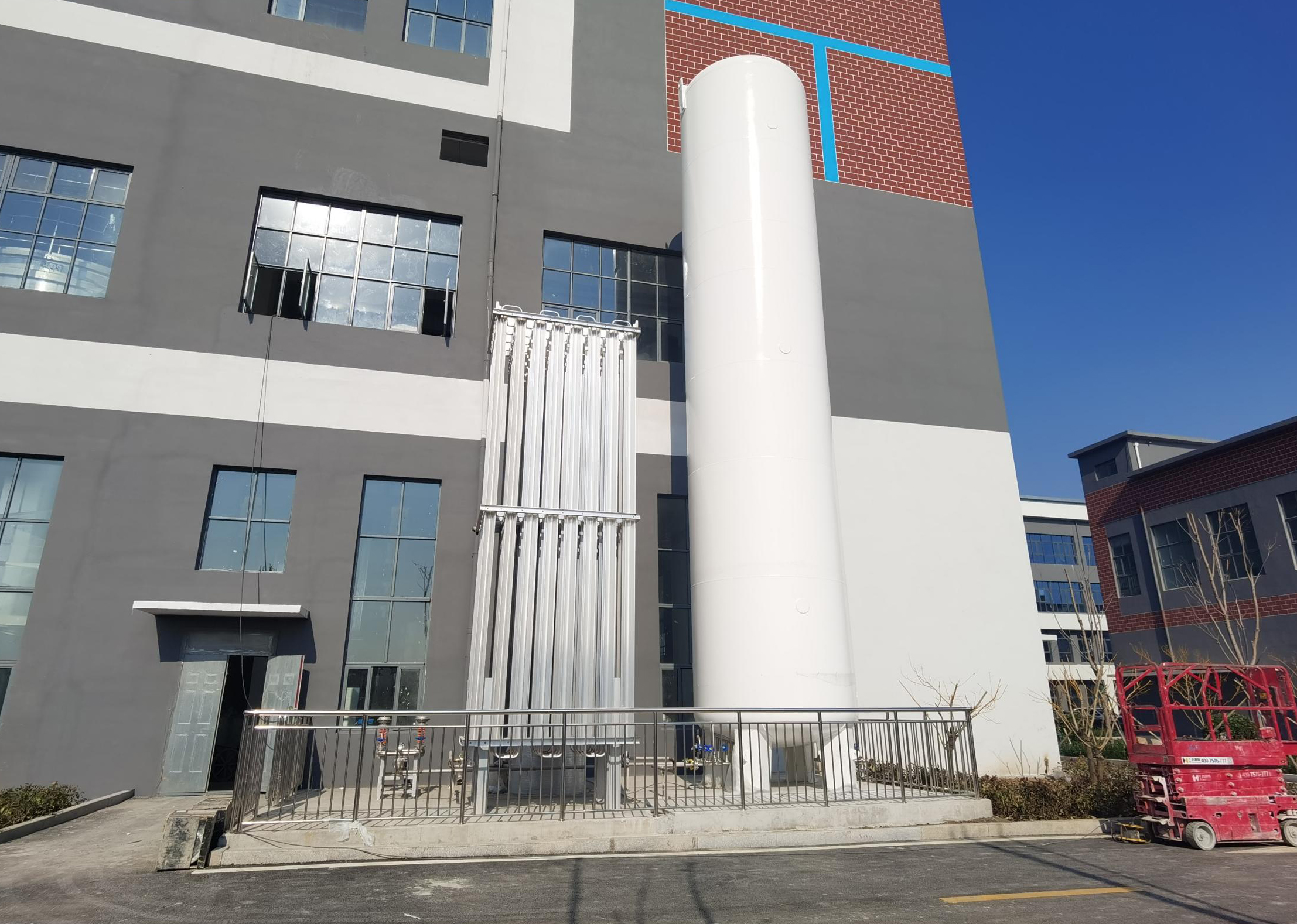
BSGS bulk gas stations are designed for high-volume inert gases such as high-purity nitrogen and liquid argon. Adopting cryogenic storage tanks, vaporizers and automatic manifold switching, it replaces frequent cylinder replacement and fits wafer fabs, photovoltaic and panel factories with heavy gas consumption.
Key design considerations:
• Size tank capacity and vaporizer redundancy based on peak consumption rather than average flow, to accommodate capacity expansion and seasonal demand surge.
• Equipped with auto-switching unit, pressure monitoring and remote alarm to realize non-stop supply during tanker swap.
• Reserve expansion interfaces for future tool addition and minimize production downtime for retrofits.
2. Electronic Specialty Gas Backup Supply: Mitigate Global Supply Chain Risks
Global supply contraction and volatile pricing of rare and electronic specialty gases have exposed single-source supply plans to huge risks. Critical specialty gases including WF₆, NF₃, silane and diborane require redundant backup configuration.
Common reliable backup designs:
• One-in-use one-standby / one-in-use two-standby automatic manifold system, seamless pressure-trigger switch without gas cut-off during cylinder change or maintenance.
• Independent nitrogen purge and vacuum evacuation loop to avoid moisture and oxygen contamination during cylinder swapping.
• Dual-source strategy: long-term contract supply plus spot backup; gas recovery and purification units are deployed for certain processes to reduce reliance on imported gas.
• Hazardous specialty gases are housed in dedicated gas cabinets with negative pressure exhaust, leak detection and emergency shut-off interlock.
3. High-Purity Gas Piping Engineering: Clean Delivery Path to Process Tools
Piping acts as the channel for gas transmission. Even minor particle contamination or micro-leakage will ruin gas quality. Electronic-grade projects widely adopt 316L EP electropolished stainless tubing, orbital automatic TIG welding and VCR fittings to reduce dead volume and outgassing.
Acceptance specifications:
• Corrosive and flammable specialty gases preferably use double-jacketed vacuum tubing with continuous interlayer leak monitoring.
• Segmented nitrogen purge and helium mass spectrometry leak test, leak rate ≤1×10⁻⁹ mbar·L/s.
• VMB valve manifold boxes for gas hook-up; separate cable trays for hazardous and inert gas lines.
• Full documentation package including purge records, leak test reports, material certificates and as-built drawings handed over for routine inspection and maintenance.
4. Value of Integrated Gas Supply Solution
The bulk gas station delivers steady bulk gas flow, the specialty gas backup system guards against supply outages, and precision high-purity piping locks in gas purity. This combined system addresses fab pain points: unstable supply, purity drift and complex on-site management.
Address: No. 90 Huadong Road, High tech Zone, Qingdao City, Shandong Province, China
E-mail: sainsgas@sainsgas.com
Tel: 18563963366
Copyright © 2024 Qingdao SAINS Gas Technology Co., Ltd. All Rights Reserved. Powered by HiCheng
