
Address: No. 90 Huadong Road, High tech Zone, Qingdao City, Shandong Province, China
E-mail: sainsgas@sainsgas.com
Tel: 18563963366

The new energy vehicle market keeps expanding. Many high-end models see surging orders right after launch, forcing production lines to scale up capacity rapidly. While most attention goes to vehicle performance and intelligent features, industrial gas suppliers and automotive manufacturers need to focus on one critical foundation: can the liquid nitrogen and high-purity shielding gas supply keep up with fast-growing production?
High-end EVs adopt stricter manufacturing standards than conventional passenger cars. Processes including laser welding, pretreatment for coating and low-temperature component tooling demand tight control over gas purity, delivery pressure and temperature accuracy. High purity nitrogen acts as shielding gas during laser welding to avoid weld oxidation and guarantee consistent weld strength and surface finish. Liquid nitrogen is used for precise temperature control in coating workshops to ensure good coating adhesion. Any fluctuation in gas supply can lead to mass defective parts and heavy economic losses.
A common mistake during gas system planning is sizing tanks, vaporizers and pipelines based on normal steady output. When orders spike and production ramps up, peak gas consumption can far exceed regular consumption. Insufficient liquid nitrogen storage capacity, inadequate vaporizer margin and limited pressure regulation buffer will trigger unstable pressure and gas shortage. Many gas service providers have encountered this scenario: automakers suddenly boost output, and existing LN2 tanks are too small. They have to rent extra tanks and arrange emergency gas delivery, raising costs and creating unplanned shutdown risks.
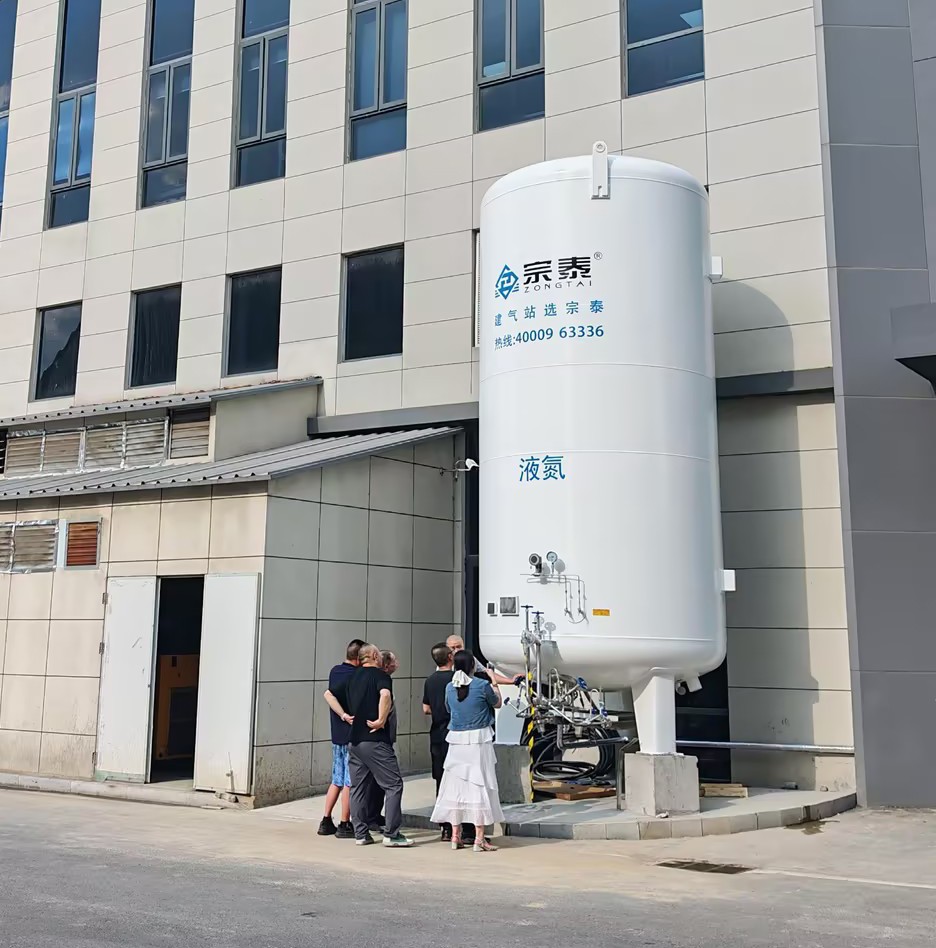
The golden rule for a reliable automotive gas system: design for maximum planned capacity, not current output.
• Calculate gas consumption: Figure out peak flow rate and continuous consumption based on full-capacity production, and reserve 20%–30% redundancy.
• Select proper storage and vaporization equipment: Match liquid nitrogen tanks, vaporizers and pressure regulators to maintain stable pressure at peak loads.
• Prepare emergency gas plans: Install backup gas ports and alternative gas sources for sudden order growth or equipment maintenance.
• Carry out routine inspection: Regularly check cryogenic tanks, vaporization units and pipelines to prevent cryogenic leakage and frost blockage.
Competition in the EV industry remains fierce, and sudden order surges can happen at any time. Qualified gas supply means more than simply having gas on site. Stable peak gas delivery that meets strict process requirements has become an invisible threshold for modern automotive production lines. Proper redundancy design helps manufacturers handle production ramp-up smoothly and avoid bottlenecks caused by unstable gas supply.
Address: No. 90 Huadong Road, High tech Zone, Qingdao City, Shandong Province, China
E-mail: sainsgas@sainsgas.com
Tel: 18563963366
Copyright © 2024 Qingdao SAINS Gas Technology Co., Ltd. All Rights Reserved. Powered by HiCheng
